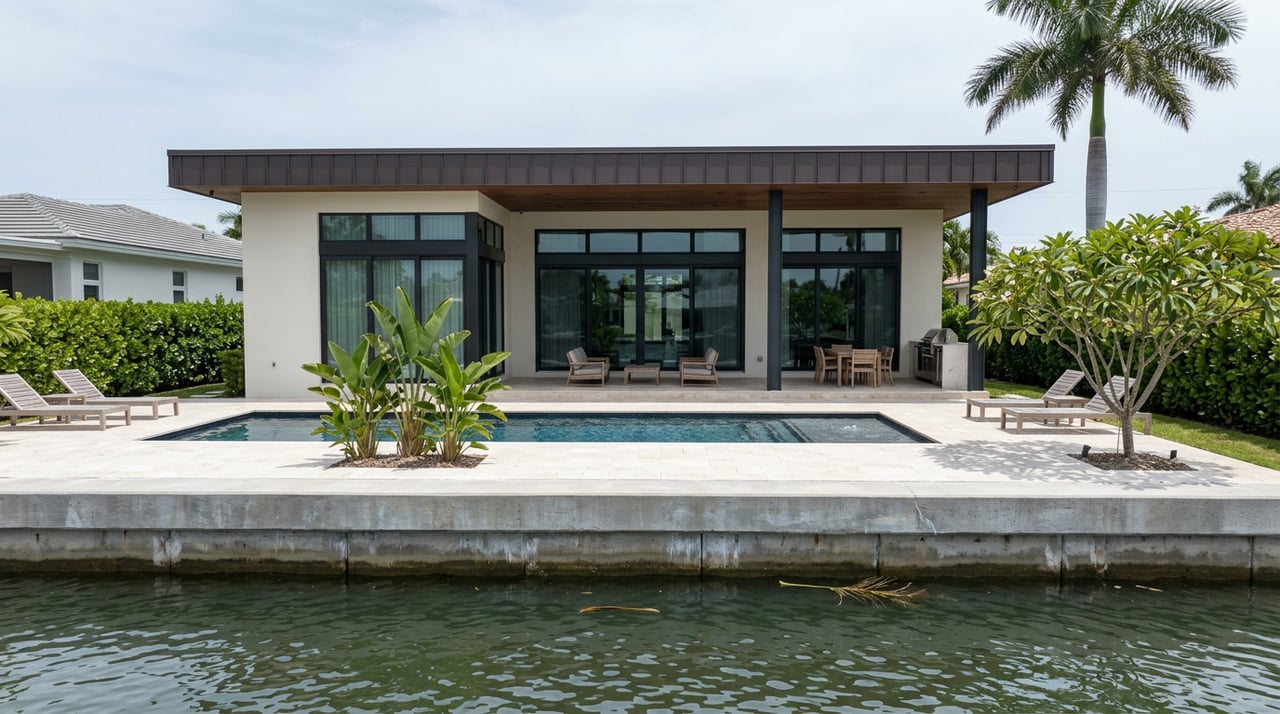
How old is the wall between your patio and Biscayne Bay?
Most Coconut Grove sellers can tell you the year their kitchen was renovated, the brand of their AC unit, and the score their last four-point inspection received. Fewer can tell you when their seawall was poured, and that gap is where Grove waterfront deals actually get won or lost. Not at the listing price. Not at the open house. At the moment a buyer's engineer walks the property line and finds a cap that hasn't been touched since Eisenhower was in office.
The Inspection That Actually Moves The Price
On South Bayshore Drive, around Dinner Key, and through enclaves like Camp Biscayne and Entrada, buyers have learned to ask for more than a survey and a home inspection report. They ask for the complete file: permits, as-builts, invoices, and any environmental studies tied to the shoreline. They want to know about past failures or repairs, and whether any permits were pulled and never closed out. That expectation has become close to standard practice for Grove waterfront purchases, and it changes the shape of a negotiation before it starts.
A conventional Miami sale treats the inspection period as a chance to find a leaky roof or an aging water heater. A Grove waterfront sale treats it as a chance to find out whether the thing holding your yard out of the bay still has ten good years left in it. Sellers who walk into that period without their own answer are negotiating from behind, because the buyer's engineer will supply the number if the seller hasn't already.
Why Grove Walls Carry More Risk Than A Typical Canal Lot
Part of what makes this different from a standard South Florida waterfront sale is the water itself. Most of Miami-Dade's canal-front seawalls deal with calmer, more contained tidal movement. Coconut Grove sits directly on Biscayne Bay, which means its shoreline absorbs open bay wind and wave energy, plus the wake generated by boat traffic moving in and out of Dinner Key. That combination puts more continuous stress on a wall than a typical interior canal ever experiences.
Age compounds the exposure. Along stretches of the South Grove bayfront, seawalls date to the 1940s through the 1960s, which puts many of them two to three decades past their original design life. Concrete carbonates over time. Reinforcement corrodes. Tiebacks lose tension slowly enough that nothing looks wrong from the patio until a cap starts to crack or a section leans. None of it announces itself early, which is exactly why a visual walk-through during a showing tells a buyer almost nothing about what they're actually purchasing.
The City's Own Shoreline Problem Is Sitting In Plain View
If you want proof that this isn't a problem private owners can simply outsource to good luck, look two blocks from the water at Peacock Park. The 9.4-acre bayfront park is the site of the city's own shoreline stabilization and kayak launch project, designed to replace an aging, eroding edge with a landscaped berm that absorbs wave energy while keeping public access to the water.
The project has been in motion since at least early 2024. As of an August 2025 status report, only Phase I, the design and permitting stage, was fully funded, covered by a $156,600 grant from the Florida Inland Navigation District and $307,980 from the City of Miami. Phase II, the actual construction, carried an estimated price tag of roughly $1.6 million and was still unfunded at that point, with the city describing a start date of July 2026 as tentative and contingent on permitting and secured money it did not yet have in hand. The plan also calls for removing a row of palms along the shoreline, which drew pushback from Grove residents who argued that mature tree canopy does its own share of flood control work.
More than a year later, that is still the most recent public accounting available. A public agency, with a dedicated capital improvements office and a specific line item, spent well over a year moving through funding gaps and community objections before its own tentative construction date even arrived. If the entity best equipped to solve a shoreline problem needed that long just to get to a start date, a private seawall built decades earlier with none of that oversight and none of that budget is not a problem that resolves itself while you wait to list.
What A Pre-Listing Check Actually Costs, And Why The Estimates Disagree
Here is where the research gets genuinely useful for a seller trying to plan ahead. Even within Florida-focused guidance, the numbers for the same line item don't always match, and that gap is itself worth paying attention to.
| Line Item | Range Reported | Notes |
|---|---|---|
| PE inspection report | $300 to $800 | Separate from any flat-fee package quoted by a marine contractor |
| Flat-fee inspection package | $1,500 to $3,000 | Quoted by contractors handling scope, diver work, and report together |
| Seawall replacement | $800 to $1,000 per linear foot | On a 100-foot lot, that is a six-figure line item |
| Recommended inspection cadence | Every 3 to 5 years | Tighter, every 2 to 3 years, for walls older than 40 years or after a named storm |
A $300 report and a $3,000 package can describe the same wall, and a 100-foot lot facing full replacement can swing from an $80,000 estimate to a $100,000 one depending on who is doing the math. None of that is a rounding error. It means a buyer's inspector and a seller's inspector could arrive at different repair numbers from the same visible cracking, and whoever supplies the first credible figure to the table usually anchors the conversation that follows.
Who Controls The Story Controls The Price
This is the part that actually changes how a Grove waterfront listing should be prepared. A wall with a decade of useful life left tells a very different story than one already losing backfill into the bay, and the signs that distinguish the two are rarely visible from a patio chair. Sellers who commission their own marine engineering report before listing get to walk into the inspection period already knowing which story they're telling. They can price around a known condition, address a minor repair before it becomes a credit negotiation, or simply hand a buyer's attorney a report that answers the question before it gets asked with leverage attached.
Sellers who skip that step aren't avoiding the cost. They're deferring it to the exact moment in the transaction when they have the least control over the number.
A Few Questions Worth Asking Before You List
Do Coconut Grove sellers have to disclose seawall condition? Florida law generally requires sellers to disclose known material defects that affect a property's value, and a documented seawall issue would typically fall into that category. This is general information, not legal advice, and any seller with specific disclosure questions should talk to a Florida real estate attorney.
Does every Grove waterfront lot carry the same seawall risk? No. Exposure varies by exact location. Properties directly on the open bay, closer to Dinner Key's wake and fetch, tend to see more wear than those tucked into calmer stretches, even within the same few blocks.
Is a pre-listing inspection worth it if the wall looks fine? The whole point is that visible condition and structural condition aren't the same thing. A wall can look clean from the yard and still have voids forming behind it. The report is what tells you which one you actually have.
If you're weighing a sale on South Bayshore Drive, near Dinner Key, or anywhere else along the Grove's shoreline, the seawall conversation is easier to have early than late. Alive Sherman works waterfront transactions across Coconut Grove and the surrounding Miami neighborhoods, and can walk you through what a pre-listing marine inspection should cover before a buyer's engineer writes the first number. Book an appointment to talk through your specific stretch of shoreline before it goes on the market.